

Why a palm-sized piece of metal outsells another tote bag — and how to
build a campaign around one.
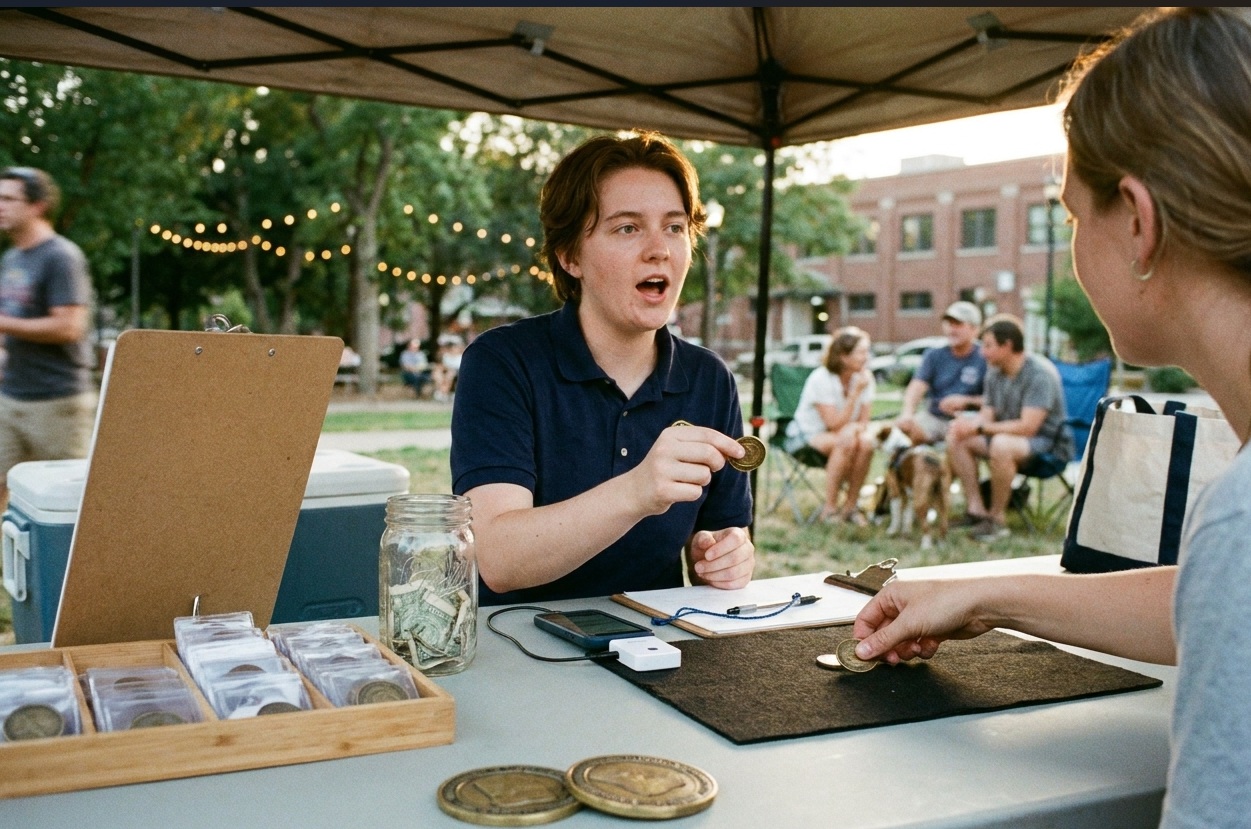
A donor walks past a table of tote bags without slowing down, but then she spots a tray of custom made challenge coins, picks one up, and turns it over twice. Something shifts in her posture…and that pause is where a challenge coin campaign earns its money.
Challenge coins began in military units and spread to police, fire departments, sports teams, car shows and beyond, but the original tradition ran on a simple rule: carry your coin, and if someone challenges you to produce it and you cannot, you buy the round of the group’s favorite beverage. A sense of unity and belonging lived in your pocket. Nonprofits, schools, alumni groups, businesses, and community clubs have since borrowed the tradition for a different purpose.
Why a custom challenge coin outperforms another branded mug
Most fundraising merchandise competes with things people already own, or things that people don’t want to own. A donor has six mugs and four t-shirts she never wears. A custom challenge coin arrives without that baggage. It reads as an artifact rather than a giveaway, and that difference shows up in what people will pay for it. A donor who ignores a $10 raffle ticket will happily hand over $20 or more for a coin she can keep.
3 inherent coin properties do the work
A coin survives. Tote bags tear, shirts fade, and pens vanish into a drawer within a month. A coin lives in a pocket or on a desk for years. Every time the donor’s thumb finds it, your cause gets a silent reminder. That is retention you do not have to buy twice.
Challenge coins start conversations: Pull one out at a ballgame and someone asks what it is. The donor tells your story for you, which beats any advertisement and costs nothing.
Unique coins invite a collection. Numbered editions, annual designs, and cause-specific series give supporters a reason to return next year. Collectors are the most reliable repeat donors you will ever find.
The arithmetic that makes finance people listen
Custom challenge coins are cheap to produce relative to what they raise. At volume, a two-inch die-struck coin with color enamel often costs a few dollars per unit. Ask a $40 gift for one and the return runs nearly ten to one before you factor anything else into the equation.
Now count everything else: Collectors buy a second coin for a spouse. A local business may cover the entire production run in exchange for its logo on the reverse, which drops your cost to zero and lifts your margin to one hundred percent.
Set tiers instead of a single price. For example, A $25 gift takes home the standard coin, but a $100 gift adds recognition on a donor wall. Here’s the real winner…A $500 gift receives a matched set in a display case.
Four formats that work for custom challenge coins and fundraising
Numbered limited edition: Produce 250 coins, stamp each one on the edge, and announce the run. Scarcity does the selling. When the last coin leaves the table, you have a waiting list for next year.
Donor tiers: Tie the coin to membership rather than to a single transaction. Sustaining members receive the annual coin automatically; everyone else can buy in. A one-time campaign becomes a renewal program.
Auctions: Auction a prototype, a signed coin, or serial number 001 at your gala. One lot can out-earn a week of online donations.
Sponsor-underwritten coin: Find a business that wants visibility with your audience. It pays for the order, you sell the coins, and every dollar stays with the cause. The sponsor gets its logo carried in hundreds of pockets.
Custom Coin Design choices that raise the price
Perceived value comes from details a donor can see and feel. A deep three-dimensional elements in your coin design reads as quality the instant someone touches it. Dual plating (gold and silver for example) and translucent enamel add depth that flat printing cannot match. Edge numbering costs little and turns a keepsake into a collectible….probably the biggest bank for the buck option available.
Keep the text short. A typical 1.75-inch coin holds a logo, a motto, and a year that is legible — not a mission statement. Put the longer story on a custom printed card tucked behind the coin in its sleeve. That card costs pennies and doubles as a thank-you note with your donation link.
Stamp the year on every coin. Dated coins age into a series, and a series creates collectors.
Where coin campaigns stumble
Ordering late: Proofs, revisions, and production consume weeks. A coin that arrives two days after the gala raises nothing, so start the conversation two months out.
Let’s get started on your custom challenge coin design and quote right away! Click below.